A story about Harvard research, pizza, a Hall-of-Fame coach, and the greatest title I’ve ever carried.
A few years ago, my sister Julie and I were in Los Angeles speaking at a conference.
As a keynote speaker, I spend a lot of time talking to audiences about resilience, leadership, overcoming adversity, and finding joy in difficult circumstances.
Ironically, one of the greatest teachers I’ve ever had on those subjects was sitting right across from me, deciding what kind of pizza to order.
“What’s your favorite pizza?” I said.
Without hesitation, she answered.
“Sausage.”
Then she thought for a moment.
“Well… unless Mom’s there. Then it’s mushrooms.”
I didn’t have to ask what she meant.
I knew Mom’s favorite pizza was mushrooms.
What struck me wasn’t that Julie knew Mom liked mushrooms.
It was that Julie didn’t say, “Mom’s favorite pizza is mushrooms.”
She said, “If Mom’s there, MY favorite is mushrooms.”
Somewhere along the way, the happiness of someone she loves had become her own happiness.
That story came back to me recently when several people asked my opinion about a famous couple who reportedly ended a pregnancy after learning their baby would have Down syndrome.
Before I go any further, I should probably confess something.
Trust me, I am the least hip person you’ll ever meet.
Actually, the fact that I just used the word “hip” should probably prove it.
I don’t know who this couple is.
I don’t know their names.
I don’t know if they’re actors, athletes, influencers, singers, reality TV stars, or people who became famous for being famous.
And honestly, I wanted to write this before I found out.
I don’t want to know what side of any issue they’re on.
I don’t want to know whether I agree with them politically.
And truthfully, I don’t even want to know whether I’d like them.
I don’t want any of those things influencing what I’m about to say.
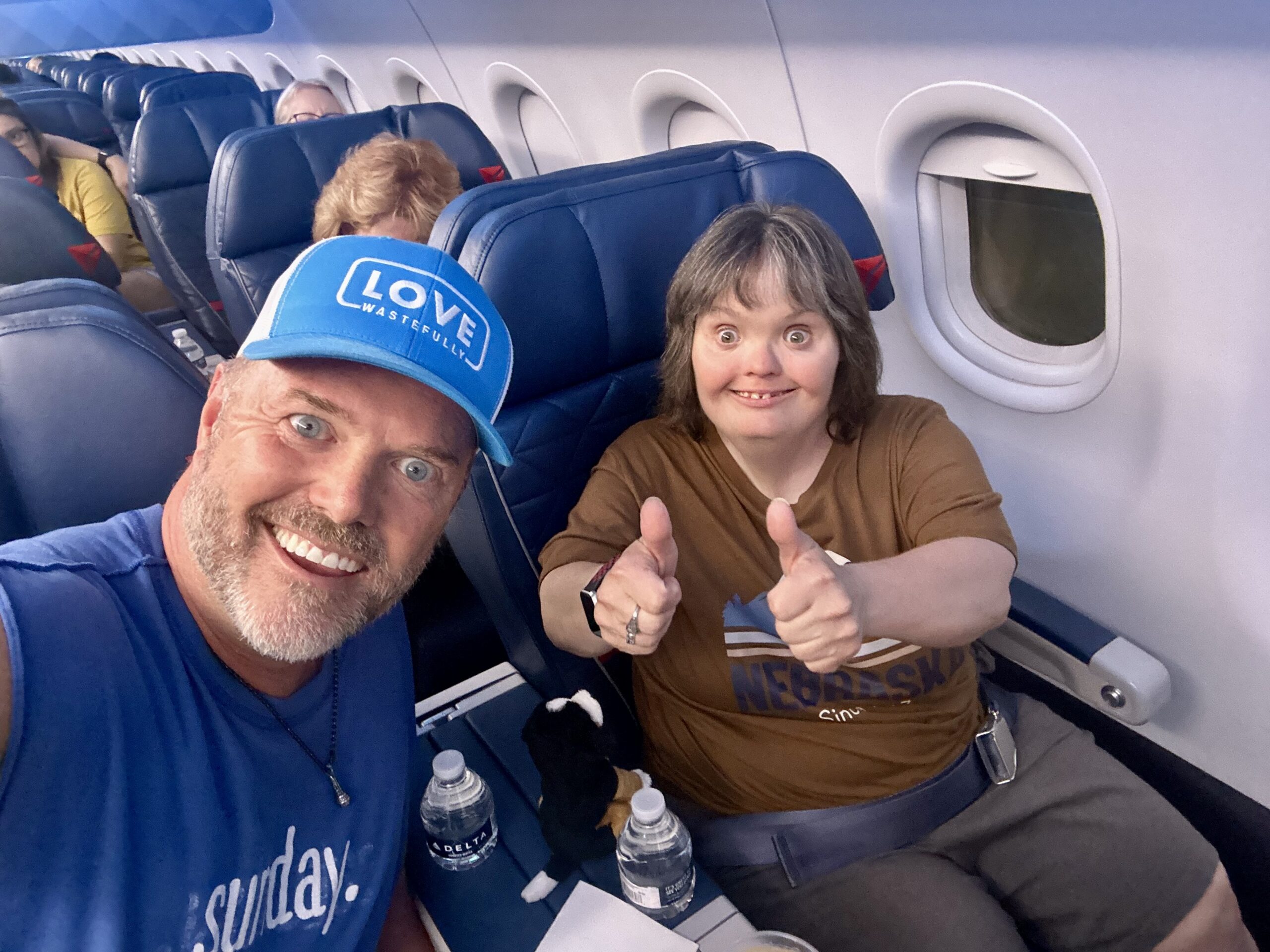
I simply want to write this as a man who has spent more than fifty years carrying the best title I’ll ever have:
“Julie’s brother.”
Julie isn’t just my sister.
She’s my best friend.
She’s my hero.
For years we’ve traveled together speaking at conferences and events around the world.
We are typically together 24/7 for days at a time.
Julie still loves me.
I don’t think there’s a typical person on earth who could pull off that incredible feat.
Today we still host a live online show together every single day.
If you’d like to join us sometime, you can find us at JuliesCoolShirts.com.
I’ve spent more time with Julie than with any other person on earth, and after all those years, her electric smile still lights me up, her contagious giggle fills my battery to full charge, and I learn from her almost every day.
When the Tennant family was surprised with a baby who had Down syndrome in 1975, I didn’t realize it at the time, but I had just hit the sibling lottery.
I realize that may sound like a strange thing to say.
Especially to someone who has never known a person with Down syndrome.
Today, many parents learn that news before their baby is born, and if they’ve never been lucky enough to know someone with Down syndrome, I can only imagine the surprise and likely fear they might feel.
Fear of the unknown is one of the most natural human emotions there is.
I don’t judge the fear.
In fact, I think it points to something important.
Maybe the answer isn’t fewer opportunities for the world to experience people with Down syndrome.
Maybe it’s more.
The more people get to know these extraordinary individuals, the harder it becomes to see them as a diagnosis rather than a person.
In 2011, Dr. Brian Skotko and his colleagues at Harvard-affiliated Boston Children’s Hospital surveyed people with Down syndrome about how they felt about their lives.
The results were remarkable.
Nearly 99% said they were happy with their lives.
Ninety-seven percent said they liked who they were.
Ninety-six percent said they liked how they looked.
The same research found that 97% of siblings expressed pride in their brother or sister with Down syndrome, and 88% believed they were better people because of that sibling.
Think about those numbers for a moment.
If we’re being honest, happiness is what nearly every human being is chasing.
We chase it through careers.
Through money.
Through relationships.
Through achievement.
Through possessions.
Through experiences.
We spend our entire lives trying to find it.
Which is why those statistics are so fascinating.
One of the few groups we can identify that consistently reports extraordinary levels of happiness isn’t a group we should be trying to understand less.
It’s a group we should be trying to understand more.
A group we should celebrate.
I don’t know many groups of people anywhere that would score even close to those numbers.
But after sharing a lifetime with Julie, I can’t say I’m surprised.
I’ve had a front-row seat to this “research” my entire life.
Sample size: one.
Her name is Julie.
One of my favorite examples happened on an airplane.
Julie and I were flying out of Syracuse when legendary SU basketball coach Jim Boeheim sat down right in front of us.
Now, if you live in Syracuse, that’s a pretty big deal.
People noticed.
You could see them whispering.
You could see them sneaking looks.
You could see them trying to act like they weren’t looking at Jim Boeheim.
But nobody was brave enough to approach him.
When I told Julie who was sitting in front of us, her eyes got huge.
“No way! Can I talk to him?”
“Of course,” I said.
She immediately jumped up, tapped him on the shoulder, and introduced herself.
Jim smiled.
Now, if you know anything about Jim Boeheim, that’s noteworthy all by itself.
I snapped a picture.
Then Julie said something I’ll never forget (and, as it turns out, neither will thousands of others).
She didn’t ask for tickets.
She didn’t ask for an autograph.
She didn’t tell him how awesome he was.
She didn’t tell him how much she loved Syracuse basketball—and trust me, she does.
Instead, she said:
“Hi, I’m Julie Tennant. If you need anything, I’m right behind you.”
And then she sat back down.
That’s it.
She simply wanted him to know that if he needed anything, she would be happy to help.
That’s Julie.
What struck me most wasn’t that she met a Hall-of-Fame coach.
It was that she treated him exactly the same way she’d treat anyone else.
That moment eventually became a TV news story after I shared it on Instagram.
If you’d like to see it for yourself, it’s available at julietennant.com.
Fair warning: you may become an even bigger Julie fan.
And that’s exactly why I wanted to tell you about Julie before I told you anything else.
This is not an article about what decision anyone should make.
I don’t know this couple.
I don’t know what fears they faced.
I don’t know what information they received.
I don’t know their circumstances.
And I certainly don’t know their hearts.
What I do know is Julie.
And I can tell you exactly what would happen if they met her.
Julie wouldn’t see herself as better than them.
She wouldn’t care how they vote.
She wouldn’t care what they believe.
She wouldn’t even care whether they agree with her.
She would walk straight up to them with that giant smile, give them one of her famous high-fives, and probably ask them what kind of pizza they like.
Then she would treat them exactly the same way she would treat anyone else.
Exactly the same.
No categories.
No scorecards.
No qualifiers.
No conditions.
Just kindness.
Just love.
To be honest, I don’t know many typical people who have that capacity.
Including me.
That’s one of the reasons Julie has spent her entire life teaching me.
When people talk about Down syndrome, they often focus on the extra chromosome.
What I’ve spent my life noticing is something else.
An extra capacity for joy.
An extra capacity for forgiveness.
An extra capacity for kindness.
An extra capacity for seeing the value in another human being.
The extra chromosome most certainly comes with challenges.
It comes with uncertainty.
It comes with fears.
It comes with things many families never expected.
I’m not pretending otherwise.
But as “Julie’s brother,” I’ve also seen something else.
I’ve seen kindness.
I’ve seen forgiveness.
I’ve seen acceptance.
I’ve seen an extra capacity to love people exactly where they are.
So while I understand why the medical community describes Down syndrome the way it does, I have to admit something.
A person having forty-seven of something when most of us only have forty-six feels less like a problem and more like an upgrade.
In fact, my grandfather used to say it wasn’t even an extra chromosome.
He said you and I were the ones MISSING it.
He called it the love chromosome.
The older I get, the more I think he was onto something.
Earlier I told you I didn’t want to know what side of any issue this couple was on.
I didn’t want to know whether I agreed with them politically.
And I didn’t even want to know whether I’d like them.
But as I finish writing this, I realize something.
Julie doesn’t know who they are either.
In fact, I’m quite certain she has no idea.
But I can promise you one thing.
She likes them.
Thank you for reading.
If this story meant something to you, I’d love to hear your thoughts in the comments.
And if you know someone who could use a little more Julie in their life, please share it with them.
— Derrick

Absolutely, 100%, written perfectly. Down syndrome is a blessing of love from God!! A rare gift, to be cherished.
Beautiful Derrick. Love to your precious Julie
Thank you Gail. I really did hit the sibling lottery!
I absolutely love this! By far, one of your best writings. Please continue to celebrate Julie and all those who God uses to teach us chromosome-short people. I pray God uses this article beyond any scope you can imagine.
Thanks Kathy! Me too. We all have so much to learn : )
Derrick, your love for your sister is so evident, as is Julie’s. Christ demonstrated love for us all on earth and you have it in such abundance. I look up to you in that way. Thank you for writing such a beautiful article.
Thanks Barry. I so hope that many get to feel Julie’s awesome love! Appreciate you!
Derrick- your posts/ articles always make me smile. I find myself always wanting to be a better me after reading your posts. Influence with love, Julie taught you well.
You’re gonna make me cry, D. Thanks for your words. You rock!
Meeting you two on the airplane (I’m no Hall of Fame coach, though) was the start of a beautiful thing! More people need to understand this unfiltered, generous love! 😘 God had a plan when he gave us Julie!
Yes C! He always has a great plan and it’s WAAAY better than ours : ). That plane ride was just as great as the Boeheim one and Julie loves YOU just the same!!!!
This article gets right to the heart of how and who we are before God, his prized children! Love you both! Your transparency is appreciated. Your honesty is appreciated. I am grateful God put you both in my life!
You are awesome G. We are so glad we know you!
What a way with words you have my friend. Brilliantly expressed, for all who have come to know, and love Julie and your family! Your family educates people as to the glorious gift it is to know/ love a person with Downs Syndrome. I’m so happy that I asked Holy Spirit to lead me all those years ago…and you were the first post popping up on my feed! It has led to many years of loving friendships with not only Julie, but all of the 321 family. I’m sure learning from Julie on a daily basis. ” JUST LOVE” is one of my favorite shirts! “LOVE WASTEFULLY” AND ” OOZE GENEROSITY” have become a couple of good phrases for my life.
God bless the 321 family and keep up your good works Derrick and Julie !
Thanks D. Julie is a great teacher, huh?
That is an awesome way of looking at things… I am so touched by the love you and Julie share. You are so connected. . . Thank you for sharing your thoughts and views on this subject. It wasn’t about if they are making the correct choice or not. It wasn’t about what they should do. You simply share how your life and so many other’s lives have been touched by having Julie in it. . . You could be harsh and say abortion is absolutely wrong, because you wouldn’t have Julie. But you look at it in a completely different way. She’s blessed your life incredibly because your parents chose to keep Julie. . . That doesn’t mean it would be the same situation for others. We ALL wish and hope everyone could handle the challenges. That they would show their child the love, grace and embrace their child the way you and your family have. But unfortunately not everyone is that way. That’s why we read about terrible / horrible situations not just with children having down syndrome or any other issues. Just simply because not everyone is the same. Not everyone can handle the changes.. . . So while you could be harsh with your opinions and thoughts – I love that you chose to write about your blessings instead. 😊
Thank you for your kind words. Julie teaches me that having love as a default will never do you wrong. I appreciate you taking time to write here : )
So,I like it
I AM BACK AGAIN